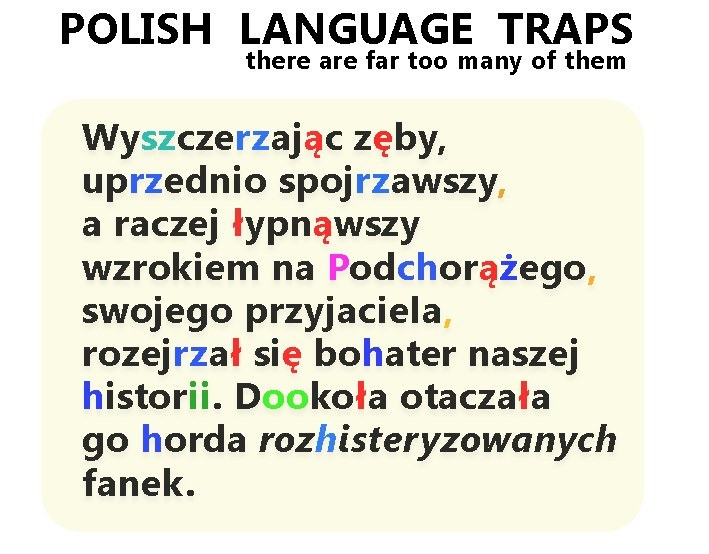
It belongs to one of the five most difficult languages in the world. A small number of Poles can use Polish without errors. Grammar rules are very complex. During organized language Olympiads consisting in saving the dictated text, the number of mistakes made is assessed. Winners are people who often get up to three mistakes, which qualifies for the main prize anyway, usually a cash reward worth the value of a cheap new car. It is forgotten than the most important role of a language is not sport competition but simple communication. Despite the mental mutilation of children forced to learn the intricate rules of the less partial language, no effort is made to simply the Polish language. This could be difficult and perhaps no longer makes sense, since in the future the Polish language will share the fate of languages that will come out of everyday use becoming an ethnographic monument.
The only good feature of the complexity of the Polish language is its plasticity. Compared to English, Polish resembles clay to English Lego blocks.
How did it happen than the grammar of the Polish language is so onerous?
Before the Slavic dialects were transformed into written language, they were supplanted by the common Latin recognized in Europe as the official language of educated people, i.e. most of them were priests. The German military strategy towards its enemy on the eastern border, which at the same time was an enemy of the Polans, helped in the acceptance of the lands of the Polans into the Christian community (X AD). The need to emphasize the fact that the Polish state was created was legalized by the marriage of the chief of Poles Mieszko and the Czech princess Dobrava. Dobrava in Poland has become a symbol of a new era and the Czech language has become very popular and fashionable.
We trace the oldest documents written in Polish to the XIII century. Polish pronunciation was recorded in the letters of the Latin alphabet but there were no letters to precisely define the differences n pronunciation between the Polish language and Latin. Each author for the text coped in its own way, among others, Czech characters were introduced as it was done in parallel with the transformation of the Czech language.
With German settlement in the Polish land, the language was enriched with new vocabulary, which in the record retained partly German grammatical forms. With the arrival of the first printing presses in the XVI century, a problem arose in font design and the need to systematize the marking of the writing method, which until now had been treated freely by manuscripts. The same words were written differently depending on the author. The period of modernization of the Polish language record had begun treated by manuscript writers.
During the partitions or occupation of the three neighboring powers, Polish language was banned. After more than a hundred years, the Polish language appeared again, but with large grammatical influences and vocabulary of the occupation countries.
During World War II, German again became compulsory in German-occupied Poland. And after the war, the second obligatory language besides Polish was Russian.
Currently, a great impact on the Polish language has a vocabulary of English origin, which is trying to polish, which is a big problem and distorts the grammar of the Polish language.
Is should be remembered that it is not the rules that decide about the language but the real need to strive for unification in communication. Civilization is still developing and its basis is communication and language community. A language that is difficult to learn and where mistakes are made has no chance of survival in the future. Grammar rules must change and no punishment or invocation of tradition will help here. This also applies to English, because the more nations use this language, the less English will be and the more human it will be. (Brux)
…………………
BRUXnews
RSS subscription: https://brux.news.blog/feed/
Editor contact: BRUXnews@post.com
 BRUXnews