Each nation has its own holy symbols, which almost in every the case of the case relase to freedom and struggle for this freedom. I is similar in Poland. The Catholic cross will be an undeniably dominant symbol in Poland. The cross has accompanied Poland since the Middle Ages and the first rules. This is one of the oldest sign symbolizing belonging to the Catholic Union of medieval Europe with the papal authorities in Rome. Poles are very strongly and traditionally associated with Catholic culture, which can be found in Poland at every step even in advertising. In Poland, Catholic religion is entered in the Act as a national religion althoug it is not obliged to profess it. And although today young generations perceive the Catholic Chrch as a burdensome and greedy for money archaism and another strength tryin to subordinate the society of hatred ideologies to everything else, the Catholic cross is still in great respect. The paces of death or grave are marked with a cross. For many Poles it is a holy place. [Post aboutit: https://brux.news.blog/2022/07/17/death-crosses-on-the-roads/].
The Catholic cress in Poland has always gainded importance during the Patriotic eforts of the fight for independence. The church and prayer to God were an element of hope for beneficial success. That is why thesse successes were very modest.
The second symbol known to all Poles but not by every Pole correctly understood is the Solidarity Movement symbol (Solidarosc). Everyone w Poland has seen this inscription-symbol and more or less associates events related do it. But not much besides. The symbol of Solidarnosc is the name of the society’s movement, which was born in the eighties in Poland as a sign of protest against the Russian occupation. After the Second Worls War, Poland liberated by Russia become a puppet state working slave to Russia. It will be difficult to udenrstand why most citizens in Poland supported this state but teh reason was simple. Everyone who expressed dissatisfaction with Polish-Russian friendship ended in a prison or dead in a ditch. And many Poles loved this stat of torturing compatriots for theri own opinion. Friendship with Russia was stronger than national cohesion. (We had very similar situation in Poland during Covid19 marketing, in 2020 where ordinary people Poles were ready to humiliate and beat those who are against wearing disgusting masks). The national consciousness of Poles is mainly determined by media belief, it can be freely controlled. Poles have a problem with independent thinking. The Russians controlled the Polish nation as they knew, but the lives of the robbed Poles were not easy. Since the end of the war, dissatisfaction and suppressed rebellion have been overwhelmed for almost 40 years. Finally, with the circumstances of the weakening of Russia by the war in Awganistan, the CIA services began to support the Polish opposition technologically.
The beliefs of Poles began to be changed on the media path to print the undergraoun press, in which the countless cases of manipulation that Poles were given by proRussian power in Poland were given. The workers’ class was treated as a slave class. Economic destabilization was encouraged as a way to weaken exports to Russia and forcing the Polish power working for Russia to make concessions to improve the working conditions and life of workers. At that time in Poland, the underground press equipped with printer duplicator brought from abroad printed many titles. A spiral of activity was filmed and many environments joined the opposition in the form of strikes at work. Each form of protest is important but this one was most liked by workers. In order for the effectiveness of strikes to be better, they began to be coordinated at the same time. Sjar committees were created, which jointly prepared protests in workplaces. It was important to respond in the situation of pacifying strikes in other plants in other cities. If a militia appeared in the factory where the strike appeared to beat the strikers, other workplaces started their strikes. The more strikes appeared, the more the Polish government lost control and helpless sensitive. This is how the idea of providing support was born under the slogan of Solidarity. During one of the strikes in Gdańsk (1980), the editor of the Strike Bulletin titled Solidarnosc (Solidarity) graphics Jurek Janiszewski decorated the usual bulletin title of the symbol of crowd carrying the Polish flag.
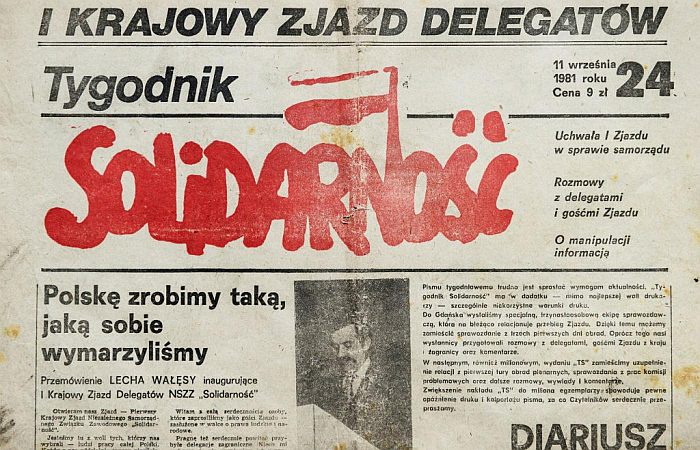
Jurek did not expect then that the monochrome logo he made would soon become one of the most recognizable signs of resistance and political rebellion. This symbol has become fashionable in Poland. He was the first symbol as popular as the symbols of foreign brands Sony or Mercedes. In this way he helped in shaping Poles’ beliefs.
There is another national symbol, which is very respected, although not every Pole associates what he means. When the Germans and Russians attacked Poland and the Second World War began, the structures of the Polish Underground State called “Fighting Poland” began to appear. At that time, the Germans picked up Russia and proudly announced their success with the symbol V (abbreviation of the word Victory propagated by the Allies). This sign compromising propaganda painted by the Germans on the walls strongly focused on the situation of Germany. He had a greater message than an article in a newspaper, in which no one believed. The Polish government, which before the war, took refuge in England, announced in the occupied Poland a competition for the symbol, for the already mentioned fighting deputy, which would not be disputed as the already known symbol V and being a symbol of the fight against the occupier. This is how an anchor was chosen with the letter P (from Poland).
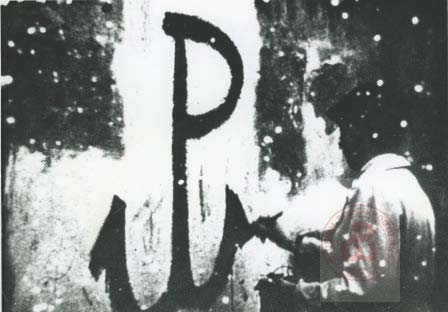
It is not known who the author of this symbol is, it is said that the scout Ania Smolenska. The first use of the sign took place in 1942 by Polish scouts from the “Wawer” sabotage organization. Anchor signs were painted on the walls at the places of sabotage. Later, he became a symbol of the entire Polish underground fighting with Germany and was supposed to remind Germany that, apart from Polish collaborators, there are also those who prefer to fight. It is a symbol that can be treated in the category of heroism of young people who died in a desperate fight against a much stronger and brutal enemy. It is less recognized than the previous two symbols that I described, but in my opinion it is the most important for every enlightened Pole, but in Poland with this enlightenment is very poor and therefore not many people know what this symbol of the anchor means. (Brux)
…………………
BRUXnews
RSS subscription: https://brux.news.blog/feed/
Editor contact: BRUX.editor@outlook.com
 BRUXnews